CAA-2026-0015 TeamPCP Supply Chain Attack Distributes Information Stealer via Trusted Dependencies
This report is distributed as TLP:CLEAR. Recipients may share this information without restriction. Information is subject to standard copyright rules.
Summary
A threat actor known as TeamPCP has conducted multiple supply chain attacks targeting popular open-source security scanners, resulting in the distribution of malicious updates containing information stealer malware. This attack, which most recently affected the widely used litellm PyPi package, presents a significant risk of threat actors gaining access to development environments that use compromised products as part of the CI/CD pipelines. Organizations must assess their environment for any dependencies on the compromised products during the timeframes that malicious versions were distributed and rotate potentially compromised credentials to prevent further attacks.
Details
Since 27 February 2026, TeamPCP compromised several open-source security scanners: Aquasecurity Trivy, Checkmarx KICS, and Checkmarx AST. The group also compromised multiple npm packages, and most recently, the litellm PyPi package. TeamPCP used their access to the development environments of these products to publish a variety of malicious versions, Visual Studio Code (VSCode) extensions, GitHub Actions, and Docker images containing information stealer malware. The information stealer is capable of extracting secrets, including:
- SSH keys
- VPN configuration files
- Git credentials
- Cloud environment credentials, such as Azure, AWS, and GCP
- Kubernetes service account tokens
- TLS private keys, and more1
Execution of any infected packages will expose organizations to opportunistic threat actors that may abuse stolen credentials, exfiltrate sensitive data, and conduct data extortion.2 SANS researchers corroborated reports of TeamPCP exfiltrating over 300GB of credentials, and partnering with the cybercriminal group LAPSUS$ to extort victims.34
TeamPCP’s Supply Chain Attack Timeline
The timeline and version numbers below can help organizations assess their exposure. Several reports provide conflicting end times for when compromised versions were active on their respective repositories and have been omitted from this report.
Trivy VSCode Extension
At 2026-02-27 12:04 (UTC), a malicious Trivy VSCode extension trivy-vulnerability-scanner version 1.8.12 was published to the OpenVSX registry. A second malicious trivy-vulnerability-scanner VSCode extension version 1.8.13 was also published to the OpenVSX registry at 2026-02-28 16:28 (UTC).5
Trivy and Associated GitHub Actions
At approximately 2026-03-19 17:43 UTC, a malicious release of Trivy version 0.69.4, as well as 83 malicious version tags for the Trivy GitHub Actions aquasecurity/trivy-action and aquasecurity/setup-trivy were published.
The maintainers at Trivy disclosed this compromise resulted from incomplete rotation of compromised credentials from the previous incident.6
CanisterWorm Attack on emilgroup, teale.io and Other npm Packages
At 2026-03-20 20:13 (UTC), TeamPCP pivoted to compromising the npm ecosystem using a self-propagating worm malware dubbed CanisterWorm. The worm published 141 malicious versions of 66 different packages. Initially, most malicious npm packages were under the scope of emilgroup and teale.io, but quickly spread to further packages from opengov, virtahealth, react, and others.7
Notably, CanisterWorm leverages an Internet Computer Control (ICP) canister for command and control (C2) communication which enables the delivery of secondary payloads. ICP is a decentralized blockchain that provides infrastructure for hosting websites, applications, and more.8 TeamPCP’s ICP canister used for C2 communication was subsequently taken offline due to violating ICP policy.
CanisterWorm also establishes persistence by creating systemd services in the context of the current user.910
Trivy Docker Images
At approximately 2026-03-22 16:00 (UTC), two malicious Aquasecurity Trivy Docker images (versions 0.69.5 and 0.69.6) were published to Docker Hub.11
Checkmarx KICS and AST VSCode Extensions
At 2026-03-23 12:53 (UTC), two Checkmarx VSCode extensions cx-dev-assist version 1.7.0 and ast-results version 2.53.0 were published to the OpenVSX registry by a compromised account.12 Several reports indicate the versions hosted on the official VSCode Marketplace were unaffected.13
Checkmarx KICS and Associated GitHub Actions for KICS and AST
At 2026-03-23 12:58 (UTC), a malicious release of KICS version 1.1, 35 GitHub Action tags for KICS (kics-github-action), and all GitHub Action tags for AST (ast-github-action) were published. Sysdig initially assessed the impact to the GitHub Action for ast-github-action was limited to just one tag; however, Wiz later assessed the compromise to have likely affected all tags.
LiteLLM PyPi Package
At 2026-03-24 10:39 (UTC), malicious versions litellm 1.82.7 and 1.82.8 were published to the PyPi marketplace. Analysts at FutureSearch note malicious versions of litellm had been downloaded over 46,000 times, demonstrating the significant blast radius of this attack.14
LiteLLM determined their internal development environment was compromised because of using Trivy for security scanning in their CI/CD pipeline. This allowed attackers to obtain credentials for the LiteLLM publishing pipeline.15
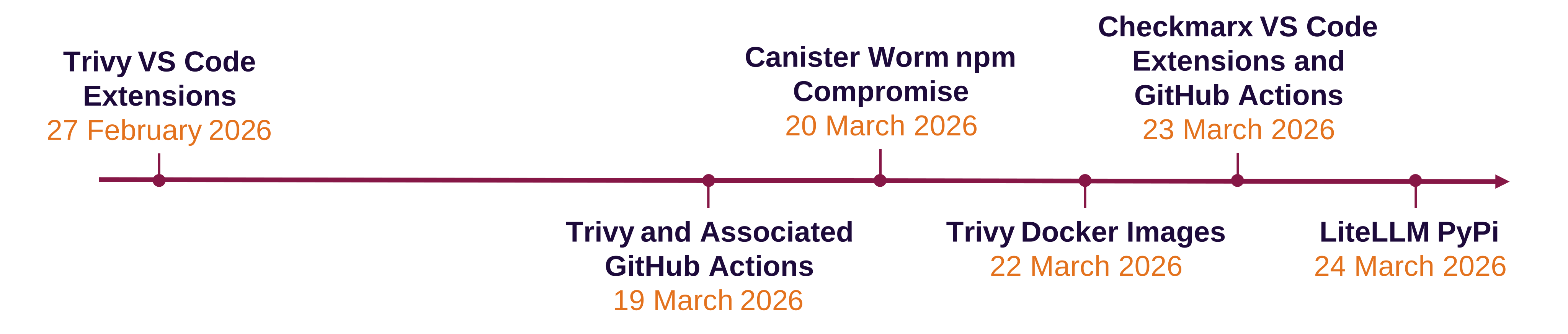
Figure 1. TeamPCP’s Supply Chain Attack Timeline
Assessment
CyberAlberta Threat Intelligence assesses that TeamPCP will likely continue attempting to compromise development environments of popular open-source projects, attracting opportunistic threat actors seeking to exploit this access.16 Similar to past Shai-Hulud campaigns, the use of self-propagating malware in supply chain attacks highlights the importance for up-to-date asset inventories so organizations can quickly determine their level of exposure.17 Moreover, as organizations and users adopt agentic workflows, code dependencies will likely grow without the explicit awareness of security teams.
Recommendations
To assess the level of exposure to TeamPCP’s supply chain attacks, organizations should:
- Confirm the presence of any of the following compromised products:
Aquasecurity Trivy VSCode extension trivy-vulnerability-scanner versions 1.8.12 and 1.8.13
Aquasecurity Trivy version 0.69.4
Aquasecurity Trivy GitHub Action Tags aquasecurity/trivy-action and aquasecurity/setup-trivy
The npm packages reported by Socket18
Aquasecurity Trivy Docker images versions 0.69.5 and 0.69.6
Checkmarx KICS OpenVSX extensions ast-results version 2.53.0 and cx-dev-assist version 1.7.0
Checkmarx KICS version 1.1
Checkmarx KICS GitHub Actions kics-github-action and ast-github-action
PyPi package litellm 1.82.7 and 1.82.8
- Determine if any malicious updates were installed during their respective timeframe of compromise.
- Exposed organizations must reset SSH keys and credentials for AWS, GCP, Azure, Kubernetes service account tokens, and cryptocurrency wallets.
- Update affected products to the latest, remediated version where appropriate.
- Developers should pin GitHub Actions by commit SHA instead of tags to remediate similar attacks relying on GitHub Actions tags.
Detection Opportunities
The following KQL queries can help detect usage of the compromised products. These queries are dependent on the products being stored in their default folder paths.
let Compromised_VS_Code_Extensions = dynamic(['trivy-vulnerability-scanner-1.8.12', 'trivy-vulnerability-scanner-1.8.13', 'checkmarx.ast-results-2.53.0', 'checkmarx.cx-dev-assist-1.7.0']); union isfuzzy=true DeviceEvents, DeviceFileEvents, DeviceNetworkEvents, DeviceProcessEvents | where Timestamp >= datetime("2026-02-27") | where InitiatingProcessCommandLine matches regex @"[\\/]\.VS Code[\\/]extensions[\\/]" or ProcessCommandLine matches regex @"[\\/]\.VS Code[\\/]extensions[\\/]" or FolderPath matches regex @"[\\/]\.VS Code[\\/]extensions[\\/]" or InitiatingProcessFolderPath matches regex @"[\\/]\.VS Code[\\/]extensions[\\/]" | extend VS Code_Extension = coalesce ( extract(@"\.VS Code[\\/]+extensions[\\/]+([^\\/]+)", 1, InitiatingProcessCommandLine), extract(@"\.VS Code[\\/]+extensions[\\/]+([^\\/]+)", 1, ProcessCommandLine), extract(@"\.VS Code[\\/]+extensions[\\/]+([^\\/]+)", 1, FolderPath), extract(@"\.VS Code[\\/]+extensions[\\/]+([^\\/]+)", 1, InitiatingProcessFolderPath) ) | where VS Code_Extension matches regex @"^[a-z0-9][a-z0-9._-]*$" and VS Code_Extension has_any (Compromised_VS_Code_Extensions) | summarize FirstSeen = min(Timestamp), LastSeen = max(Timestamp) by VS Code_Extension, DeviceName, InitiatingProcessAccountName | sort by LastSeen desc |
Figure 2. KQL Query for Identifying VSCode Extensions
union isfuzzy=true DeviceEvents, DeviceFileEvents, DeviceNetworkEvents, DeviceProcessEvents | where Timestamp >= datetime("2026-03-20") | where InitiatingProcessCommandLine matches regex @"[\\/]+node_modules[\\/]+" or ProcessCommandLine matches regex @"[\\/]+node_modules[\\/]+" or FolderPath matches regex @"[\\/]+node_modules[\\/]+" or InitiatingProcessFolderPath matches regex @"[\\/]+node_modules[\\/]+" | extend npm_Package = coalesce ( extract(@"node_modules[\\/]+@?([^\\/]+)", 1, InitiatingProcessCommandLine), extract(@"node_modules[\\/]+@?([^\\/]+)", 1, ProcessCommandLine), extract(@"node_modules[\\/]+@?([^\\/]+)", 1, FolderPath), extract(@"node_modules[\\/]+@?([^\\/]+)", 1, InitiatingProcessFolderPath) ) | where npm_Package matches regex @"^[a-z0-9][a-z0-9._-]*$" | summarize FirstSeen = min(Timestamp), LastSeen = max(Timestamp) by npm_Package, DeviceName, InitiatingProcessAccountName | sort by LastSeen desc |
Figure 3. KQL Query for Identifying npm Package Installs since TeamPCP’s CanisterWorm Attack
union isfuzzy=true DeviceEvents, DeviceFileEvents, DeviceNetworkEvents, DeviceProcessEvents | where Timestamp >= datetime("2026-03-24") | where InitiatingProcessCommandLine matches regex @"[\\/]+site-packages[\\/]+" or ProcessCommandLine matches regex @"[\\/]+site-packages[\\/]+" or FolderPath matches regex @"[\\/]+site-packages[\\/]+" or InitiatingProcessFolderPath matches regex @"[\\/]+site-packages[\\/]+" | extend PyPi_Package = coalesce ( extract(@"site-packages[\\/]+([^\\/]+)", 1, InitiatingProcessCommandLine), extract(@"site-packages[\\/]+([^\\/]+)", 1, ProcessCommandLine), extract(@"site-packages[\\/]+([^\\/]+)", 1, FolderPath), extract(@"site-packages[\\/]+([^\\/]+)", 1, InitiatingProcessFolderPath) ) | where PyPi_Package matches regex @"^[a-z0-9][a-z0-9_-]*$" | where PyPi_Package contains "litellm" | summarize FirstSeen = min(Timestamp), LastSeen = max(Timestamp) by PyPi_Package, DeviceName, InitiatingProcessAccountName | sort by LastSeen desc |
Figure 4. KQL Query for Identifying Installs of LiteLLM PyPi Packages Since the The Start of The Compromise
Indicators of Compromise (IOCs)
The following IOCs characterize TeamPCP’s activity described in this report.
| Description | Indicator |
| Informaiton stealer, C2 domains | scan.aquasecurtiy[.]org |
| plug-tab-protective-relay.trycloudflare[.]com | |
| models.litellm[.]cloud | |
| checkmarx[.]zone | |
| Information stealer, C2 IP | 45.148.10[.]212 |
| Informaiton stealer, SHA256 hash | 18a24f83e807479438dcab7a1804c51a00dafc1d526698a66e0640d1e5dd671a |
| 887e1f5b5b50162a60bd03b66269e0ae545d0aef0583c1c5b00972152ad7e073 | |
| f7084b0229dce605ccc5506b14acd4d954a496da4b6134a294844ca8d601970d | |
| 822dd269ec10459572dfaaefe163dae693c344249a0161953f0d5cdd110bd2a0 | |
| bef7e2c5a92c4fa4af17791efc1e46311c0f304796f1172fce192f5efc40f5d7 | |
| e64e152afe2c722d750f10259626f357cdea40420c5eedae37969fbf13abbecf | |
| ecce7ae5ffc9f57bb70efd3ea136a2923f701334a8cd47d4fbf01a97fd22859c | |
| d5edd791021b966fb6af0ace09319ace7b97d6642363ef27b3d5056ca654a94c | |
| e6310d8a003d7ac101a6b1cd39ff6c6a88ee454b767c1bdce143e04bc1113243 | |
| 6328a34b26a63423b555a61f89a6a0525a534e9c88584c815d937910f1ddd538 | |
| 0880819ef821cff918960a39c1c1aada55a5593c61c608ea9215da858a86e349 | |
| CanisterWorm, ICP canister C2 | tdtqy-oyaaa-aaaae-af2dq-cai.raw.icp0[.]io |
| CanisterWorm test payload, SHA256 hash | e9b1e069efc778c1e77fb3f5fcc3bd3580bbc810604cbf4347897ddb4b8c163b |
| 0c0d206d5e68c0cf64d57ffa8bc5b1dad54f2dda52f24e96e02e237498cb9c3a | |
| CanisterWorm ICP backdoor payload, SHA256 hash | 61ff00a81b19624adaad425b9129ba2f312f4ab76fb5ddc2c628a5037d31a4ba |
| CanisterWorm self-propagating backdoor payload, SHA256 hash | c37c0ae9641d2e5329fcdee847a756bf1140fdb7f0b7c78a40fdc39055e7d926 |
| CanisterWorm self-propagating worm, SHA256 hash | f398f06eefcd3558c38820a397e3193856e4e6e7c67f81ecc8e533275284b152 |
| 7df6cef7ab9aae2ea08f2f872f6456b5d51d896ddda907a238cd6668ccdc4bb7 | |
| 5e2ba7c4c53fa6e0cef58011acdd50682cf83fb7b989712d2fcf1b5173bad956 | |
| OpenVSX Extension ast-results-2.53.0.vsix, SHA256 hash | 65bd72fcddaf938cefdf55b3323ad29f649a65d4ddd6aea09afa974dfc7f105d |
| OpenVSX Extension cx-dev-assist-1.7.0.vsix, SHA256 hash | 744c9d61b66bcd2bb5474d9afeee6c00bb7e0cd32535781da188b80eb59383e0 |
| OpenVSX Extension checkmarx-util-1.0.4.tgz, SHA256 hash | 0d66d8c7e02574ff0d3443de0585af19c903d12466d88573ed82ec788655975c |
| OpenVSX Extension environmentAuthChecker.js, SHA256 hash | 527f795a201a6bc114394c4cfd1c74dce97381989f51a4661aafbc93a4439e90 |
Table 1. TeamPCP Indicators of Compromise
References
[1] https://socket.dev/blog/trivy-under-attack-again-github-actions-compromise
[2] https://socket.dev/blog/teampcp-targeting-security-tools-across-oss-ecosystem
[3] https://www.linkedin.com/posts/mccartypaul_infosec-teampcp-lapsus-activity-7442235107521982465-2tsZ/
[4] https://www.sans.org/blog/when-security-scanner-became-weapon-inside-teampcp-supply-chain-campaign
[5] https://socket.dev/blog/unauthorized-ai-agent-execution-code-published-to-openvsx-in-aqua-trivy-vs-code-extension
[6] https://github.com/aquasecurity/trivy/security/advisories/GHSA-69fq-xp46-6x23
[7] https://socket.dev/supply-chain-attacks/canisterworm
[8] https://learn.internetcomputer.org/hc/en-us/articles/33152818663444-What-is-ICP
[9] https://www.aikido.dev/blog/teampcp-deploys-worm-npm-trivy-compromise
[10] https://www.endorlabs.com/learn/canisterworm
[11] https://www.wiz.io/blog/trivy-compromised-teampcp-supply-chain-attack
[12] https://checkmarx.com/blog/checkmarx-security-update/
[13] https://www.wiz.io/blog/teampcp-attack-kics-github-action#compromised-artifacts-43
[14] https://futuresearch.ai/blog/litellm-hack-were-you-one-of-the-47000/
[15] https://docs.litellm.ai/blog/security-update-march-2026
[16] https://x.com/intelrat/status/2036924437908373618
[17] https://cyberalberta.ca/the-scattering-the-shai
[18] https://socket.dev/supply-chain-attacks/canisterworm